The Archives nationales are the national archives of France. Created by decree of the Constituent Assembly in 1790, they are inseparable from the Assemblée constituante in their early history. The institution preserves the archives of the central organs of the French State, except those of the ministries of Armies, Economy and Finance, and Europe and Foreign Affairs, which have their own archive services. Its headquarters is located in Pierrefitte-sur-Seine, while some archives are kept in Paris.
The two sites conserve a total of linear archives documenting the history of France from an unspecified date to the present. The Archives nationales depend on the ministry in charge of cultural affairs, a status they have held since 1959. Their documents may be reused free of charge. The institution’s historical development includes the appointment of an archivist by the Assemblée constituante, the centralizing law of 7 messidor an II, and the decree of 8 prairial an VIII, which placed the Archives nationales under direct government authority.
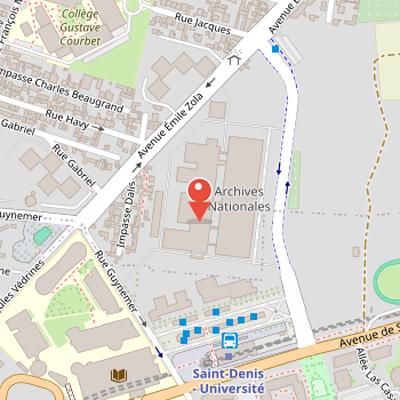
Role and Location of the National Archives
The Archives nationales preserve the archives of the central organs of the French State, except those of the ministries of Armies, Economy and Finance, and Europe and Foreign Affairs. It was created by decree of the Constituent Assembly in 1790 and has depended on the ministry in charge of cultural affairs since that ministry was established in 1959. The headquarters of the institution is in Pierrefitte-sur-Seine, while some of its archives are kept in Paris. Together, these two sites conserve a total linear archives documenting the history of France from an unspecified date to the present.
Some nationally important archives are preserved by other services, including the Overseas National Archives in Aix-en-Provence and the National Archives of the World of Work in Roubaix. The ministries excluded from the Archives nationales each have their own archive services: the Service historique de la Defense, the service des archives economiques et financieres, and the Archives diplomatiques. Archives of decentralized state services are preserved by the Departmental Archives. The reuse rights for documents preserved by the Archives nationales are free.
Founding and Early Organization
The Archives nationales are inseparable from the Assemblee constituante, which appointed an archivist and established a conservation deposit by regulation. Armand Gaston Camus, elected archivist by the Assemblée constituante, is presented as the tireless creator of the institution and of the decree that defined it. The founding law set out the organization and objectives of the Archives nationales, while the first decree limited its scope to the archives of the Assemblée and of previously suppressed institutions. The institution was intended to preserve paper archives from the Estates General of 1789, as well as foundational objects of the Republic such as seals and weights. The same framework also directed manuscripts on science and arts to libraries, including the Bibliotheque nationale, for instruction. To manage these transfers, the law created a temporary agency for sorting documents for the Bibliotheque nationale and the Archives nationales; this agency later became the Bureau. It also made it possible for the Archives nationales to receive unexpected collections, including ecclesiastical funds and emigre papers. The law of 7 messidor an II gave the institution a centralizing imprint and affirmed legislative power over it in article III. This legislative control ended under the Consulat with the decree of 8 prairial an VIII, which placed the Archives nationales under direct government authority and assigned the Premier consul the decision on the appointment of the Garde des Archives nationales.
Historic Movements of the Archives nationales
The Archives nationales first occupied one room of the Assembliee constituante in Versailles before being moved to Paris by decree. In Paris, they were initially placed in the Feuillants library on rue Saint-Honore, then transferred to the former Capucins convent on the same street. At this location, an iron cabinet used to store assignat plates was installed; it remains at the Archives nationales today. The arrival of laws, decrees, and constitutional acts in the archives also reflected their symbolic link with legislative power.
In 1793, the Convention moved the archives to the Tuileries palace, where they remained until 1800. That year, they were transferred to the palais Bourbon together with the library. The iron cabinet, however, stayed at the Tuileries. In parallel, the archives in the capital were theoretically divided in 1793 under Camus into two sections: judicial archives and domanial-administrative archives. The judicial section was kept in the Palais de justice and the Sainte-Chapelle, while the domanial and administrative archives were held in the Louvre and later in the palais Bourbon under the Consulat.
Missions and archival organization
The Archives nationales operate under the ministry in charge of Culture and the general directorate of Patrimoines, which defines, coordinates, and evaluates State policy on architecture, archives, museums, monumental heritage, and archaeology. As a national competence service, they work across three sites in Paris, Fontainebleau, and Pierrefitte-sur-Seine. Certain collections of national importance are also conserved in the Archives nationales d'outre-mer in Aix-en-Provence and the Archives nationales du monde du travail in Roubaix.
Their missions cover collection, classification, conservation, restoration, communication, and public enhancement of archives from central State services and central powers, from the origin to the present day. These responsibilities are exercised under delegated powers from the heritage code and in close collaboration with the Missions bureau of the Interministerial Service of Archives of France (SIAF). The policy for private archives is determined according to the competencies of the Archives nationales d'outre-mer and the Archives nationales du monde du travail.
The collections bring together archives from individuals, families, associations, and institutions of national historical importance, acquired by donation, deposit, bequest, purchase, or dation. Public archives come from ministries and administrations, including holdings from the Ancien Regime and more recent periods. Classification follows the methodical framework created by Pierre Daunou in 1808. The system reflects historical choices that created chronological and institutional breaks in the collections, and some study fields require detailed examination of large series. For collections after 1958, classification continues according to the year of transfer.
Collection and Access
The Archives nationales carry out one of the four traditional archivist missions, collection, alongside classification, conservation, and communication. In this context, collection means all actions used to acquire new archival entries and enrich the preserved holdings. Public archives in France are subject to mandatory and regulatory delivery to an archives service, and the Archives nationales operate within the Service interministériel des Archives de France under the direction generale des Patrimoines, with an archivist network in each public document issuing institution. They coordinate and organize regular archive collection and subsequent consultations with the Missions des Archives de France, which are placed directly at ministries to advise, establish conservation rules, and assist with the delivery of definitive conservation documents.
The Archives nationales also receive private archives of national importance, so that public origin holdings can be enriched and completed. These private collections can arrive by various means. Among the examples cited, Valery Giscard dEstaing initiated the systematic delivery of presidency papers to the Archives nationales during his presidency, and all of his successors followed this practice. He also delivered 4200 archival items in 1981 at the end of his term.
Communication is presented as the fundamental mission of the Archives nationales, and classification and the creation of finding aids are necessary for public access. Classification may concern archives from distant periods, including both old and modern, public and private archives. Reprocessing operations have been carried out to comply with recommendations from the Service interministériel des Archives de France and the International Council on Archives. These operations are accompanied by finding aids made available to the public in reading rooms or virtual inventory rooms. Contemporary archives are kept at the Pierrefitte-sur-Seine site, while for public archives arriving at Pierrefitte-sur-Seine or Fontainebleau, the content and research tools are pre validated by the fonds service. Some fonds, especially private fonds, are processed or reprocessed on site after transfer and receive a new inventory. The PRIAM3 online orientation database provides access to summaries of public and private transfers and links to detailed digital directories made by the missions and accessible in the reading rooms of the three sites.
Conservation and archival missions
The Statuts et missions describe archival preservation as a combined intellectual and material responsibility. Archivists are said not to separate the conservation of intellectual patrimony from the conservation of the physical supports, since archival documents are fragile and were originally produced for administrative needs rather than to last for centuries. The documents face multiple risks, including insects, molds, water, paper acidity, and inks. To address these threats, the statutes distinguish between preventive conservation, curative preservation, restoration, and support transfer.
Preventive conservation at the Archives nationales focuses on acting on the environment without touching the documents. It aims to identify conservation conditions such as humidity, light, poor storage, and biological attacks, while also taking into account negligence, incompetence, and malice. The statutes also require archive buildings to provide a suitable climatic environment for conservation, and conditioning materials must have specific physico-chemical properties. For storage, archivists use sturdy boxes with chemical neutrality close to pH 7, adapted in size to the folders they contain. The most common box type in Paris is the black conservation cardboard box used by most archive services, and this model meets specifications set by the conservation department of the Archives nationales. Jean-Yves Ribault designed nine successive cardboard container prototypes in Fontainebleau, which led to a specially manufactured cardboard container for the Archives nationales.
The conservation department manages all conservation areas at the Archives nationales. It is composed of a scientific pole, a preservation pole, and a restoration pole. The restoration pole coordinates restoration and gilding workshops, while restoration work directly intervenes on document supports to restore integrity and legibility. The statutes state that restoration is based on principles of compatibility, legibility, reversibility, and stability, and that art technicians at the Archives nationales have high expertise for both internal and outsourced restoration control. Curative conservation includes dust removal, packaging, refills, quarantines, disinfection, and deacidification.
The department also manages media transfer to safeguard information when original supports wear or degrade. Transfer methods include copying, photocopying, microfilming, photographing, and digitization. These measures are linked to the broader requirement to avoid handling original documents during consultations. The statutes further state that digitization and microfilming support access while protecting the originals.
The communication of archives is presented as a fundamental democratic principle, and the law of 7 messidor an II is identified as organizing the archives of the Republic. Research assistance is described as a prerequisite to archive communication at the Archives nationales reception and research center. Archives are also used for rights justification, scientific research documentation, and by amateurs of history and genealogy.
Consultation Spaces and Reading Rooms
The Archives nationales includes consultation rooms for readers at each site. In Paris, the CARAN building contains a consultation room that brings together research tools and original document consultation. The same site also includes a microfilm room and specialized services in onomastics and Parisian topography. At Pierrefitte-sur-Seine, there is an original documents consultation room, an inventory consultation room, and a microfilm room on the same level. The Fontainebleau site also has a consultation room. A reading room in the ground floor of the hotel de Soubise was established in 1847, showing an early role for public consultation at the institution. The reading room design at Pierrefitte-sur-Seine involved significant consultation with future users, indicating attention to practical use and reader needs.
Access, Digitization, and Public Use
The Archives nationales have undertaken digitization and microfilming of many archival collections, alongside the creation of a new archival information system that aligns with their vocation. Their stated aim is to open archives to the broadest public possible, while also expanding their online presence beyond physical reading rooms. For regular users, this includes online procedures and remote access to resources, and for a wider new audience it includes additional digital tools such as image banks and educational files. The Pierrefitte-sur-Seine project marked an important step in this shift by initiating the dematerialization of all research instruments and creating a virtual inventory room for electronic research instruments.
At the same time, traditional consultation remains available on site in reading rooms for external publics. Archives are also communicated to producers through an administrative procedure. The institution preserves documents that are mostly considered public archives under the heritage code, and public communication follows that code. Immediate communicability is the rule, but delays may apply in order to protect legal interests such as privacy rights and research needs. Some categories, including notarial minutes and INSEE inquiry responses, are subject to fixed communication periods. Researchers may sometimes gain access before the end of a delay with authority approval, while private archives may be communicated only under the conditions set by donors or depositors.
The Archives nationales also apply a policy of free reuse for documents they preserve. They recognize a principle of free public information in documents produced or received by the institution, and Decision 2017-11 repealed the earlier tariff decision on data reuse fees. This decision must be posted in reading rooms and on the Archives nationales website. The right of reuse is free, worldwide, and unlimited in duration, except for copyrighted information and for information communicated only after special authorization or derogation.
The Paris Site of the National Archives
Since 1808, the Archives nationales have been located around the Hotel de Soubise in the Marais district of Paris, with the site later expanded in 1927 to include the Hotel de Rohan. The French state acquired the Hotel de Rohan and Hotel de Soubise property in 1808, and the Paris site was originally designed to store the archives of central state organs. It was also assigned additional responsibilities, including the Central Notarial Archives and private documents. Early planning for the site included the transfer of fonds, for which Jacques Cellerier was assigned travaux at Hotel de Soubise. The institution also decided to keep the Section legislative and administrative for future growth, and historical, domaniale, and topographic archives were planned for the first floor of Hotel de Soubise.
The Paris site now stores Ancien Regime archives, Paris notarial minutes, library collections, and, since 2013, the National Archives Museum. The museum presents temporary exhibitions and a permanent exhibition of emblematic archival documents. The library includes an administrative part classified in series AD and a general collection focused on archival science, French history, and auxiliary historical sciences. Communications of printed documents are managed at CARAN, located at 11 rue des Quatre-Fils, in a building inaugurated in 1988. The organization also includes scientific dissemination officers, partnership officers, and general affairs officers, and it had both investment and operating budgets in 2015.
Expansion and Fireproofing of the Archives
The Archives nationales faced repeated pressure on their premises as the number of holdings increased. At first, the library was intended to be located in the chapel, but after the transfer of archives began, the available spaces proved too small. The organisation therefore requisitioned hangars installed by entrepreneur Chenevard in the courtyard of Soubise. The growth in arrivals was linked in part to the Napoleonic conquests and the incorporation of new countries, and this expansion encouraged more ambitious building plans.
One early project was a Palais des Archives planned between the Invalides and the pont d'Iena. Napoleon laid the first stone on Saint-Napoleon day, and the building was intended for a new administrative district facing the Palais du Roi de Rome on the Champ de Mars. Architect Jacques Cellerier was charged with its construction, but work was stopped in 1815 after the fall of the Empire. During the Restoration, archives were returned to liberated countries.
By the 1830s, the condition of the Archives nationales again became a concern. The hotel de Soubise was in advanced disrepair and required necessary work, and on 16 December 1827 deputy Marie Louis Anicet de Blanc de Guizard criticized the condition of the archives. In 1838, the organisation commissioned Charles Lelong and Edouard Dubois for a new project. Their plan consisted of a complex of conservation buildings and offices, built with stone, iron, and pottery materials to make the structure fireproof. The building was completed in 1848, when it received the archives of the Judicial Section and the archives transferred from the Palais de justice. Those archives joined the Parliament gallery for conservation.
Even after 1848, storage remained limited. The rooms built under Louis-Philippe were too small, so new construction projects were planned. Charles Lelong proposed several unfinished projects before 1855, and in 1858 director Leon de Laborde requested funds from Finance Minister Fould. A later extension was planned along the rue Quatre-Fils, based on Hubert Janniard's proposal. To limit damage from moisture, the organisation used the most impermeable rock possible and installed a lead sheet in the walls to prevent rising damp by capillarity. The first floor installation was completed in 1865, as shown by a plaque in the Salle du Tresor des chartes.
Htel de Rohan and the Archives nationales
The Archives nationales occupies the hotel de Rohan dit de Rohan-Strasbourg at 87 rue Vieille-du-Temple, where it replaced the Imprimerie nationale. The building was preserved from destruction with the support of the Commission du Vieux Paris and the Societe centrale des architectes, and it received classification as a monument historique by the commission des Monuments historiques. The Archives also retained the bas-relief des Chevaux du soleil by Robert Le Lorrain, which had been classed since 1900.
The institution expanded under Charles-Victor Langlois, who arrived in 1913, and was definitively allocated the hotel de Rohan by decree after the departure of the Imprimerie nationale in 1926. After this allocation, administrative document deposits increased. The Archives then commissioned architect Robert Danis for renovation works that included the reconstitution of courts and gardens. His project was approved by the commission des Monuments historiques in 1928 for parts of the building.
Between 1927 and 1938, construction works were carried out on the corps de logis. During this phase, partitions used for the functioning of the Imprimerie nationale were destroyed, the grand staircase was reconstructed, and the salons on the first floor were restored. The building was inaugurated by President Albert Lebrun.
The Archives nationales also began reinstalling the decors and woodwork of the former hotel de Voyer dArgenson in the hotel de Rohan. These elements came from the hotel de Voyer dArgenson, built in 1705 by Germain Boffrand. The institution preserved the classified monument historique hotel, which had been delisted in 1923 and demolished for Banque de France expansion. Works financed by Banque de France, WMF, and the Ministry of Culture were completed later, and the hotel de Rohan was opened to the public with bi-monthly guided visits.
Earlier, the director Leon de Laborde had gradually remodeled the rooms of the hotel de Soubise. He also remodeled the oval salon of the hotel de Soubise in order to restore paintings for a museum. The Archives nationales opened a Museum of the History of France, inaugurated in 1867, showing that the site served both archival and museum functions. The Archives buildings were also saved from destruction through the intervention of the communard Louis-Guillaume Debock.
The Fontainebleau Archives Site
In 1969, the Organisation des Archives nationales created the Cite interministerielle des Archives (CIA) for the central State administration archives. The project grew out of a 1962 survey that estimated the holdings at 43 linear kilometers, including both existing and future documents. Fontainebleau was selected for the site because of Paris region planning and the return of the terrain formerly occupied by the NATO European headquarters. Prime Minister Georges Pompidou allocated 4 hectares of Camp Guynemer for the project, following Charles de Gaulle's 1966 decision to withdraw French armies from NATO integrated command.
The site was intended to extend and strengthen the actions of the Missions des Archives nationales begun in the 1950s. Its purpose was to remove documents not needed for daily use from central administration offices so they could be preserved properly, while also eliminating documents without value and equipping durable conservation facilities with research tools. This policy also aimed to bring archives institutions closer to administrative services, with financial participation from those services, although the administrations did not contribute to the functioning of the interministerial city.
The Fontainebleau site later took on several specialized roles. After the creation of a reading room there, access to the archives was removed from CARAN. The site was dedicated to preserving private architect archives and fonds seri els du . From the early 1980s, it was also assigned to collect, treat, and conserve digital archives from state and public operators. More than of electronic archives were preserved with the Constance system, and electronic files dating from the early 1960s were kept there and could be consulted in the Fontainebleau reading room. The site also conserved sound and audiovisual archives requiring specific treatment. It occupied a parcel on the edge of the castle park and national road 6 near Paris.
The Planned Archival Center
The Organisation des Archives nationales first installed archives in NATO heritage buildings with shelving, before moving ahead with specialized construction. Its original project was based on a 1962 survey of linear estimates and planned ten units, but only two were built. In the mid-1980s, the purpose of the site changed from an interim installation to a definitive archival center.
Units 1 and 2 were built in 1977 and 1984, both designed by Claude Aureau. Each unit provided capacity measured in linear meters across five basement levels. Unit 2 included facilities for special archives conservation, a microfilming workshop, and an electronic archives processing room. The interior design of both units followed industrial design principles.
The entrance hall of unit 1 was marked by a monumental staircase known as the diapason. The original decorative elements included beech wood stairs, polished regional stone, beech paneling, metal false ceilings, tubular wood furniture, textile-covered metal chairs, and colored doors and ceilings.
Pierrefitte-sur-Seine and the New Archives Strategy
In 2004, the Organisation des Archives nationales decided to build a new Centre des Archives nationales at Pierrefitte-sur-Seine in response to public alerts about archive saturation and poor conservation conditions. The decision reflected earlier concerns, including a 1994 report by Guy Braibant calling for urgent action and a 1999 statement by Philippe Belaval on the need for a new archives strategy. The planned approach was to keep in Paris only documents predating the French Revolution, while transferring other holdings to the new site. A previously proposed Maison de la memoire de la Republique at Reims was abandoned, in part because Reims was considered geographically distant from the ministries producing archives and because researchers strongly opposed that location. In 2001, the organisation also formed a user and archivist association, Cite pour les Archives nationales, led by Annette Wieviorka and Isabelle Neuschwander, with support from Martine de Boisdeffre, director of Archives de France.
The new building at Pierrefitte-sur-Seine was announced with support from local government entities. It was designed by Massimiliano Fuksas as a ten-story structure, 64 meters high and 150 meters long, with anodized aluminum cladding. The building was planned to be energy efficient and to allow for a future installation of 1,200 photovoltaic panels. It was presented in 2013 among twelve projects for the Equerre d'argent award. Another modern building was also constructed in 2007 by Hamonic+Masson, with a storage capacity of 35,000 linear meters, awaiting archive transfers to the Pierrefitte-sur-Seine center.
The transfer process continued over time. After protecting two buildings that presented a risk of collapse, the Organisation des Archives nationales closed a site in 2018 and redeployed 44 agents to two other sites. By the end of 2018, audiovisual and electronic archives had been moved to the Paris site, and the remaining archives were planned to move to the Pierrefitte site between 2019 and 2021.
Pierrefitte-sur-Seine and the Modern Archives Nationales
The Pierrefitte-sur-Seine site of the Archives nationales was developed in the 2020s in response to underestimated transfers and the closure of the Fontainebleau site. It was chosen in part because of its proximity to a metro station, and Massimiliano Fuksas was appointed as the architect of the new building. The cornerstone was laid by Prime Minister Francois Fillon.
The site was dedicated to archives postdating the French Revolution, and linear archives were transferred there from both the Paris site and the Fontainebleau site. In parallel with the building, the organization initiated a complete reorganization based on reconditioning, digitization, and the development of a new IT system. It also planned to make almost all research instruments available on the Internet.
The collections at Pierrefitte-sur-Seine were organized into five sections, including executive and legislative archives, as well as records from the Interior and Justice administrations, the Education, Culture, and Social Affairs administrations, and the Men and Territories group, covering sectors such as Agriculture, Industry, and Economy. Private archives were also included. An extension of the site was planned for 2040 in order to increase conservation capacity and avoid saturation.
Archives Held by the Archives nationales
The Archives nationales holds a wide range of archival holdings connected to public administration, cultural institutions, and private sources linked to ministerial departments. Its collections include the archives of the ORTF transferred during its dissolution, archives of ministerial cabinets, and archives of the services of the Prime Minister. It also contains archives of the Centre national de la cinematographie, the Fonds de Moscou, and the fonds of the Cite internationale universitaire de Paris. Among its other holdings are the Phototheque du Tourisme, the phototheque of the Ministry of Agriculture, and audiovisual fonds belonging to the institution.
In addition to institutional records, the Archives nationales collects private fonds from persons or private organizations linked to ministerial departments. One specific example is the archives of Pierre Laroque, related to the setup of Social Security between 1930 and 1932. These holdings show the institution's role as a repository for both official records and selected private archives connected to the functioning of public administration.
Digital Archiving and the Adamant Project
Archives nationales manages native digital archives through the Adamant software, which has been in use since 2018. The Adamant software project was launched in 2015 and is included in the Vitam interministerial archiving program. This reflects the institution's role in organizing and preserving files in digital form through a structured archiving system.
Public Access and Accessibility
Publics were not always a central concern for archivists and archival services, but at the Archives nationales there was a progressive awareness of public issues from the 1990s onward. In the 2000s, this development took place in a new context shaped by the massive digitization of archival collections and the reform of university studies. At the same time, the Archives nationales observed the first signs of stagnation in readership, while also noting that reader behavior differed according to the archival site, a variation explained by the nature of the conserved documents.
Accessibility became a visible part of this approach. The site used character magnification software to support access, equipped reception points with hearing loops for the hearing impaired, and took accessibility into account in temporary exhibitions. In recognition of these efforts, the Archives nationales received the 2016 Patrimoine pour tous prize in the category of state cultural establishments.
Cultural and Artistic Activities
The cultural and artistic activities at Archives nationales include an artistic action component within the PSCE, offering an expanded and renewed vision of the institution's identity and missions. These activities reflect the growing use of archives by artists working in performing arts, visual arts, and literature, and they provide a complementary perspective on memory, the passage of time, traces, and both collective and individual remembrance. They also highlight the poetic potential of archives and keep the artistic action component at Archives nationales as a space for research, invention, and reflection on the relationship between art and the archive.
This approach gives Archives nationales additional visibility by creating meaning from historical material and helps affirm its role as a cultural institution through unique and innovative projects. It also attracts new audiences through educational cultural action projects that connect archives and creation. The activities include artist residencies, performances, festival hosting, and university research projects. They rely strongly on partnerships between Archives nationales and networks of cultural actors and institutions, and they maintain privileged relationships with scientific partners for study days, seminars, and exhibitions.
Research Access and Archival Tools
At the Archives nationales, access to collections is organized through a set of digital and paper research tools. A new archival information system, SIA, was implemented at the Pierrefitte-sur-Seine site, and it also enabled consultation of most research instruments in the Paris, Pierrefitte-sur-Seine, and Fontainebleau reading rooms. The institution created a virtual inventory room, or SIV, to guide researchers in its collections and to provide several entry points for research.
The SIV includes research aid sheets, a general orientation plan, and search forms. It also allows users to query the Leonore, Arcade, and Archim databases, and to consult many research instruments through general or specialized search forms. In addition, it provides access to producers' notices alongside research instruments, and to archives digitized during specific campaigns. Databases serve as an additional means of access to the archives.
The general orientation plan describes the Archives nationales collections in four main categories: ancient regime, contemporary period, private origin archives, and Paris notaries' minutes. It also gives access to the list of research instruments describing the archival collections. Thematic research aid sheets are made available as initial research entry points. Paper versions of research instruments are kept for materials that have not yet been digitized or made available online.